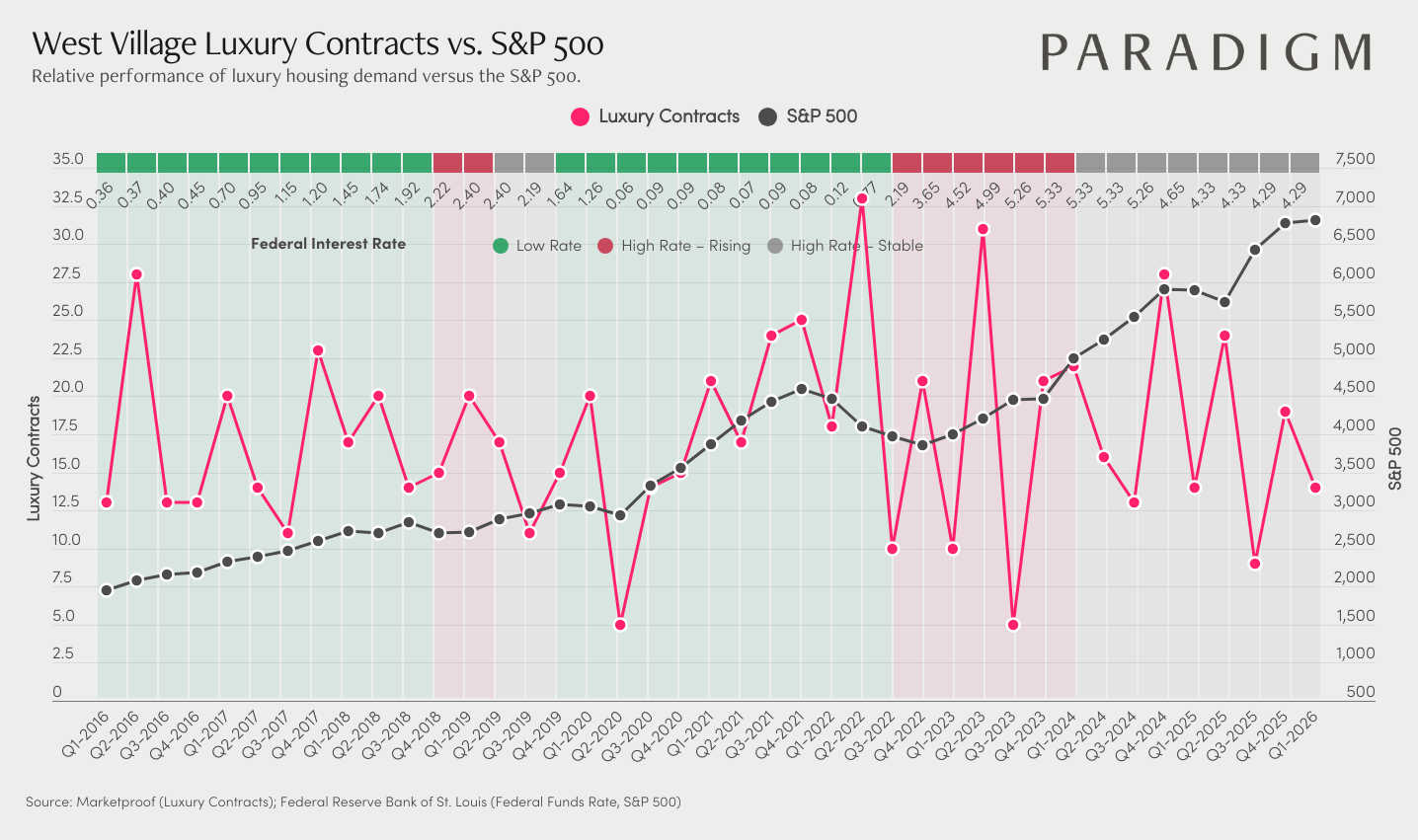
The West Village has historically produced some of the sharpest swings in $4M+ contract activity of any Manhattan submarket. Volume hit 28 contracts in Q2 2016 and has shown a consistent pattern of rapid moves in both directions, which comes down to the nature of this market. Inventory is limited, and when high-value townhouse or boutique condo deals close, they create outsized quarterly swings that you simply do not see in higher-volume neighborhoods.
That volatility is what makes the West Village story compelling. Since 2022, contracts have bounced between 5 and 30, with notable spikes in early 2022 and again in Q1 2023 showing that premium buyers still move decisively when the right product comes to market. In a neighborhood this tight on inventory, one or two transactions can shift the quarterly picture dramatically, and the West Village has demonstrated that pattern repeatedly over the past decade.
With contract volume currently running in the 13 to 18 range heading into 2026, and the S&P sitting near 6,500, the gap between equity wealth creation and local luxury activity is wider than this neighborhood's history would suggest is sustainable. The wealth environment has moved well ahead of where transaction volume is right now.
For buyers, the West Village remains one of Manhattan's most supply-constrained luxury markets, and the current volume level means a less competitive environment than this neighborhood typically produces. For sellers, when velocity turns here it tends to move quickly, as both the 2016 and 2022 spikes showed, and the advantage goes to those who are positioned ahead of that shift.
It is also worth noting that deals like 80 Clarkson and 140 Jane never appear in this data at all -- off-market transactions of that caliber move entirely outside public contract reporting, which means the true level of high-value activity in this submarket is likely understated by what any graph can show.
These charts plot $4M+ luxury contracts against the S&P 500 from 2016 through early 2026, overlaid with the average federal interest rates. It shows how luxury buyer demand has responded to shifting rate conditions, and where it stands relative to a decade of equity market growth.